Welding is the backbone of Canada’s industrial landscape. From the bustling automotive plants in Ontario to the massive structural steel projects shaping our cities, different projects demand different welding techniques.
Choosing the right welding method is essential for ensuring structural integrity, aesthetics, and cost-effectiveness. Whether you are looking for custom metal fabrication or on-site structural repairs, here is a breakdown of the most common types of welding used across Canada today.
1. MIG Welding (GMAW - Gas Metal Arc Welding)
The Go-To for Speed and Versatility
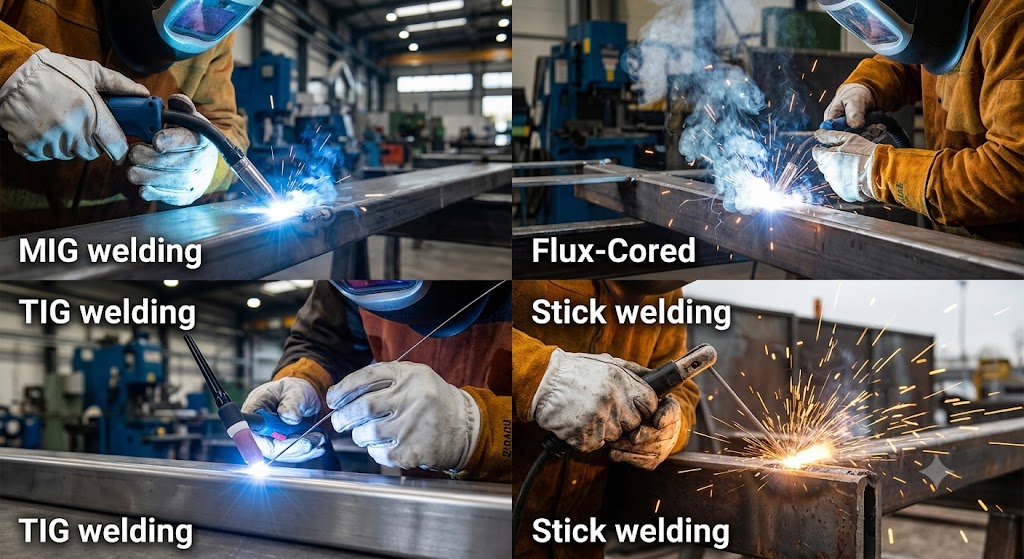
MIG welding is one of the most popular methods in both shop environments and manufacturing. It uses a continuously fed solid wire electrode acting as both the filler metal and the arc starter, shielded by an external gas (typically argon or $CO_2$) to protect the weld from contaminants.
- Best Used For: Automotive repairs, manufacturing, sheet metal fabrication, and DIY projects.
- Pros: Highly efficient, fast, easy to learn, and produces clean welds with minimal cleanup.
- Cons: Less effective outdoors because wind can blow away the shielding gas, compromising the weld.
2. TIG Welding (GTAW - Gas Tungsten Arc Welding)
The Peak of Precision and Aesthetics
TIG welding is a highly specialized technique that utilizes a non-consumable tungsten electrode to produce the weld. The welder manually feeds a separate filler rod into the weld pool while using a foot pedal or hand control to precisely manage the heat.
- Best Used For: Aerospace components, custom piping, food-grade stainless steel equipment, and intricate artwork.
- Pros: Offers unmatched precision, works beautifully on thin materials, and produces exceptionally clean, high-quality welds with zero splatter.
- Cons: Much slower than other methods and requires a highly skilled, experienced welder.
3. Stick Welding (SMAW - Shielded Metal Arc Welding)
The Rugged King of Outdoor and Mobile Welding
Stick welding is the oldest and most traditional method, but it remains incredibly vital in Canada. It uses a consumable electrode covered with a flux coat. As the stick melts, the flux creates a shielding gas and slag that protects the weld pool.
- Best Used For: Construction sites, pipeline welding, heavy machinery repair, and outdoor mobile welding services.
- Pros: Highly portable, works incredibly well outdoors (even in windy or rainy Canadian weather), and can cut through rust, paint, and dirty metal.
- Cons: Produces a lot of slag that must be chipped away after welding; not ideal for thin metals.
4. Flux-Cored Arc Welding (FCAW)
The Powerhouse for Heavy Industrial Projects
Flux-cored welding is similar to MIG welding, but instead of a solid wire, it uses a hollow wire filled with flux. It can be "self-shielded" (requiring no external gas cylinder) or "dual-shielded" (using both flux and external gas for maximum strength).
- Best Used For: Heavy structural steel fabrication, shipbuilding, and thick industrial equipment repairs.
- Pros: Extremely fast deposition rate (bonds metal quickly), deep penetration into thick metals, and great for outdoor use when self-shielded.
- Cons: Generates significant smoke and fumes, requiring proper ventilation and PPE.
Choosing the Right Welding Method for Your Project
Selecting the perfect welding type depends entirely on your specific needs:
- Need a clean, beautiful finish on aluminum or stainless steel? TIG is your answer.
- Need a fast, reliable shop repair on a steel frame? MIG is the way to go.
- Need an emergency repair outdoors on a construction site or farm equipment? Stick or Flux-Cored will get the job done right.
At Welding Services, we match the right technology and expertise to your specific project, ensuring every weld complies with CSA standards and stands up to the toughest Canadian conditions.